
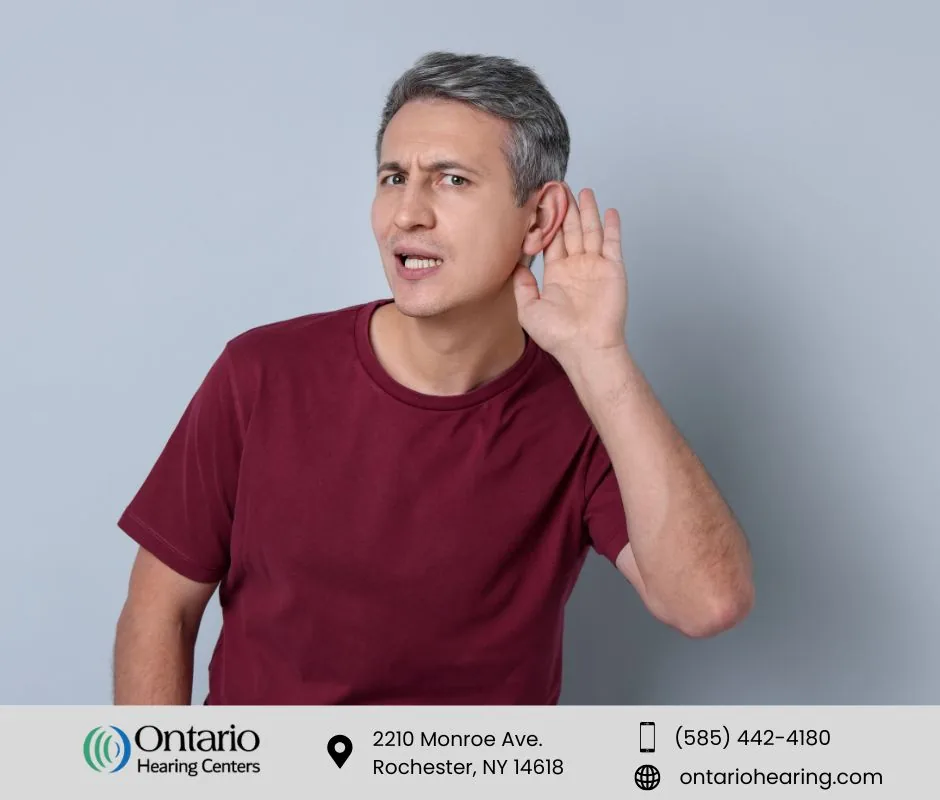
When voices sound muffled, the issue is often clarity, not volume, and sensorineural hearing loss is a common cause.
Many diseases, noise exposure, trauma, and inner ear conditions can affect how the brain understands speech.
Ontario Hearing Center provides complete hearing tests, diagnosis, and treatment options in Rochester, NY to help restore speech clarity.
Have you noticed that voices sound muffled, even when people are speaking clearly? Maybe you hear sounds, but words don’t make sense. You might feel like people are mumbling or talking too fast. This is a very common concern and it often points to a hearing condition called sensorineural hearing loss.
At Ontario Hearing Center in Rochester, NY, many patients tell us the same thing: “I can hear noise, but I can’t understand speech.” This article explains why voices sound muffled, what it may mean for your hearing health, and when it’s time to get a hearing test and see a hearing professional or audiologist.
What Does It Mean When Voices Sound Muffled?
Words blending together
Trouble hearing consonants like “s,” “t,” or “f”
Difficulty understanding speech in noise
Needing frequent repeats
This often happens even when volume seems loud enough. That’s because hearing involves how the brain processes sound, not just how loud something is.
Hearing Goes Beyond The Ears
Your hearing system includes:
The outer ear
The middle ear
The inner ear (cochlea)
The auditory nerves
The brain
Sound travels through each part. If any part is damaged by disease, inflammation, infection, trauma, or long-term exposure to loud noise, hearing clarity can suffer.
What Is Sensorineural Hearing Loss?
Sensorineural hearing loss happens when there is damage to:
The cochlea
The auditory nerves
The sound pathways leading to the brain
This is the most common type of hearing loss and often develops slowly. It can affect one ear or both ears and may occur at any age.
Why Sensorineural Hearing Loss Causes Muffled Speech
Speech is made of many sound frequencies. High-frequency sounds help us understand words clearly. Sensorineural hearing loss often affects these high frequencies first.
When this happens:
Vowels stay loud
Consonants fade
Speech sounds unclear
This is why people say:
“I hear noise but not words”
“Voices sound muffled”
“People sound like they’re mumbling”
Common Causes of Sensorineural Hearing Loss
There are many causes, including:
Noise Exposure
Long-term exposure to loud noises damages tiny hair cells in the cochlea. This damage is permanent and often leads to muffled speech.
Aging
Age-related hearing loss is very common and usually affects speech clarity first.
Disease and Medical Conditions
Certain diseases such as diabetes, autoimmune disorders, or circulation problems can damage hearing nerves.
Trauma
Head trauma or sudden pressure changes can injure the inner ear or auditory nerves.
Infections and Inflammation
Severe ear infections or inner ear inflammation can impact hearing clarity.
Genetics and Congenital Conditions
Some people are born with hearing loss or develop it early due to inherited conditions.
Special Inner Ear Conditions That Affect Speech
Some specific conditions can cause muffled hearing:
Ménière Disease
This inner ear disease can cause:
Hearing loss
Ringing in the ears (tinnitus)
Fullness in the ear
Dizziness
Speech clarity may change during flare-ups.
Acoustic Neuroma (Neuroma)
This is a non-cancerous tumor that grows on the auditory nerve. It may cause:
One-sided hearing loss
Muffled speech
Tinnitus
Balance problems
Doctors may use an MRI to diagnose this condition.
Tinnitus and Muffled Hearing Often Occur Together
Tinnitus is the perception of noises like ringing, buzzing, or hissing when no sound is present. Many patients with tinnitus also have sensorineural hearing loss.
When hearing clarity drops:
The brain tries to fill in missing sound
This can increase tinnitus awareness
Speech becomes harder to understand
Treating hearing loss often helps reduce tinnitus symptoms. Ontario Hearing Center connects you to expert audiologists handling hearing loss and tinnitus in Rochester, NY.
Could It Be an Ear Infection or Wax?
Sometimes, muffled hearing is caused by:
Earwax blockage
Middle ear infection
Fluid buildup
These usually cause sudden changes and may affect only one ear. Sensorineural hearing loss, however, develops slowly and does not improve with cleaning or medication alone.
Why Hearing Tests Matter
Many people guess what’s causing their hearing problems. Hearing tests provide real answers.
At Ontario Hearing Center, hearing tests help us:
Measure hearing across frequencies
Identify the type of hearing loss
Rule out medical causes
Decide if referral to an otolaryngologist (ear, nose, and throat doctor) is needed
Testing is painless and provides valuable information for diagnosis.
When Medical Imaging Is Needed
In some cases, additional testing is required. A doctor may recommend:
MRI scans
Blood tests
Medical evaluations
This helps rule out tumors, nerve damage, or rare diseases affecting hearing.
Treatment Options for Sensorineural Hearing Loss
While this condition is usually permanent, there are many effective treatments.
Hearing Aids
Modern hearing aids improve clarity by:
Amplifying speech frequencies
Reducing background noise
Supporting brain processing
Cochlear Implants
For severe hearing loss or deafness, cochlear implants may be an option. These devices bypass damaged parts of the cochlea and send sound signals directly to the nerves.
Medications
In certain cases, such as sudden hearing loss, corticosteroids may help reduce inflammation if treated quickly.
Counseling and Support
Hearing loss affects emotional health. Counseling helps patients adjust and manage stress and frustration.
Why Early Diagnosis Matters
Delaying treatment can lead to:
Increased difficulty understanding speech
Social withdrawal
Listening fatigue
Anxiety
Early diagnosis improves long-term success and quality of life.
When Should You See a Doctor or Audiologist?
You should seek care if:
Voices sound muffled often
You struggle to follow conversations
You have tinnitus
One ear hears worse than the other
Hearing changes after illness or trauma
An audiologist can guide you and refer you to a doctor or ENT specialist when needed.
Hearing Care in Rochester, NY
At Ontario Hearing Center, we believe hearing care should be clear, supportive, and personal. We take time to explain results, answer questions, and discuss all treatment options.
We help patients understand:
Their hearing condition
The role of the brain in hearing
Available treatments
Next steps for care
If voices sound muffled, your hearing system may not be delivering clear sound to the brain. Sensorineural hearing loss is a common cause, but it doesn’t mean you’re out of options.
With the right tests, diagnosis, and treatment, many people regain confidence and communication clarity.
Ontario Hearing Center proudly serves Rochester, NY, helping patients understand speech, manage tinnitus, and improve quality of life.
Schedule Your Hearing Evaluation in Rochester, NY Today
If voices sound muffled or unclear, contact Ontario Hearing Center in Rochester, NY to schedule a hearing test and get trusted information from hearing experts.